Research Direction

CRISPR RNP delivery

Transient editor exposure, stability vs delivery tradeoffs, and formulation decisions grounded in in vivo readouts.

Focus

The limiting step for in vivo genome editing is delivery: getting an editor into the right cells at useful levels with controlled exposure. I develop non-viral CRISPR RNP delivery built around PERCEPT, a modular platform that allows targeting ligands and formulation chemistry be changed at the final step, enabling direct, matched in vivo comparisons. After local administration, PERCEPT has produced strong editing in the CNS and retina and has also performed well in lung and skeletal muscle, motivating a single platform to iterate across tissue environments and pinpoint the constraints that limit editing.
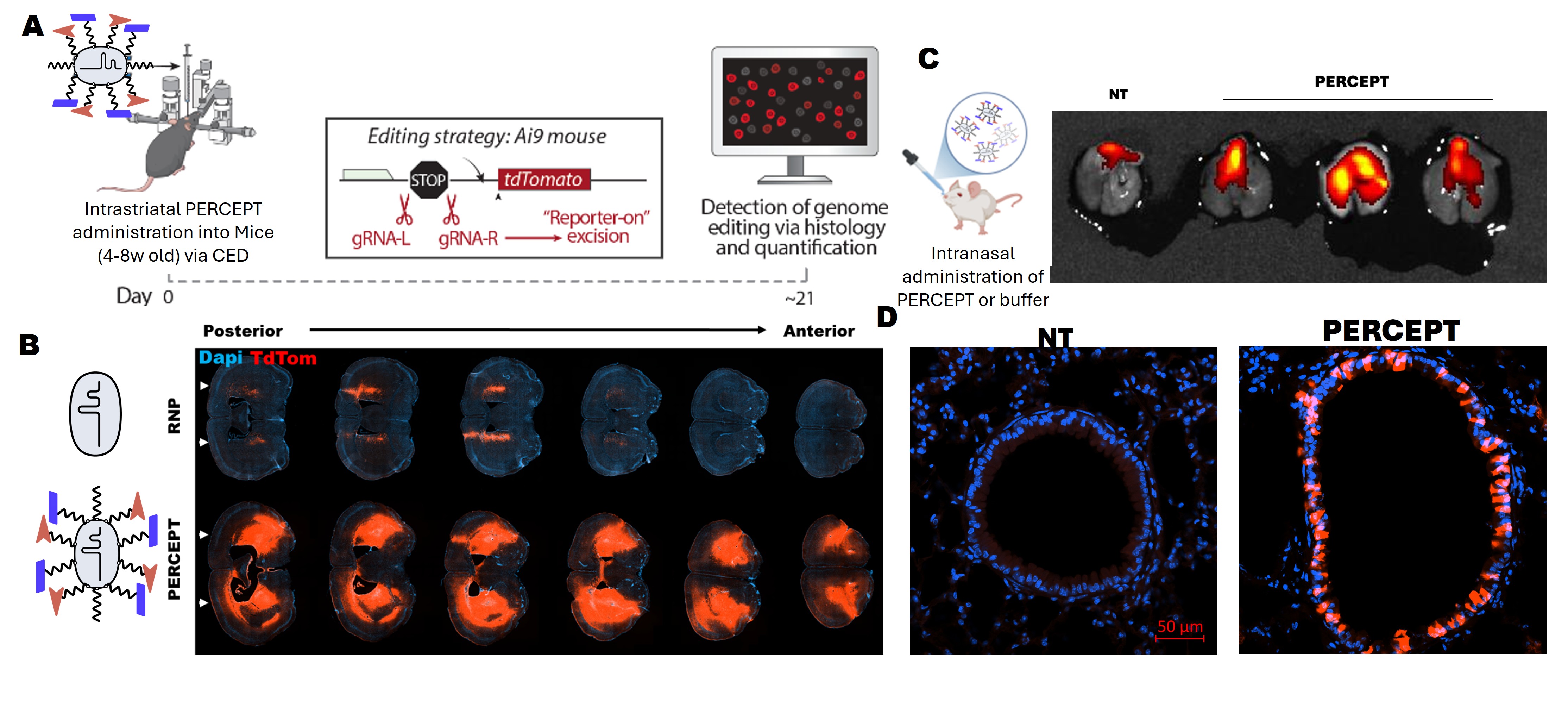
Figure

PERCEPT for local, targeted delivery figure.
PERCEPT increases local CNS editing and enables airway epithelial delivery. (A) Study schematic: PERCEPT RNPs were administered by intrastriatal convection-enhanced delivery (CED) to Ai9 “reporter-on” mice (approximately 4–8 weeks old; day 0. Paired gRNAs (gRNA-L and gRNA-R) flank the STOP cassette; excision activates tdTomato expression. Brains were collected at approximately day 21 for histology and quantification. (B) Serial coronal brain sections (posterior to anterior) stained with DAPI (blue) and tdTomato (red), comparing unmodified RNP (top) and PERCEPT-functionalized RNP (bottom). (C) Whole lungs harvested from mice treated via intranasal administration with PERCEPT or buffer and imaged on an IVIS system. (D) Representative airway cross-sections stained with DAPI (blue) and tdTomato (red), showing reporter activation in the airway epithelium (left, unmodified RNP; right, PERCEPT). Scale bar, 50 μm.

How I evaluate formulations

  • Use matched, head-to-head formulations that isolate a single design variable.
  • Measure composition, physical stability, and handling robustness alongside functional performance.
  • Bring in vivo editing readouts in early, so decisions follow biological outcome rather than surrogate metrics.
  • Apply a consistent assay stack across tissues and targets to support clear comparisons.